Wednesday, April 28, 2021

‘$50K Three Ways’ Reveals the Best Upgrades on a Small Renovation Budget

50K Three Ways

HGTV

Ever wonder what’s the best way to spend your renovation budget? A new HGTV show can help you figure that out called “$50K Three Ways,” starring Tiffany Brooks.

Brooks, the 2013 winner of the network’s “Design Star,” now helps clients decide how to fix up their home when they’re working with around $50,000. She gives them three options, and they choose their favorite, then sit back and watch as their space is transformed.

The premiere features back-to-back episodes, “Forever Farmhouse” and “Breaking Bland.” In the first, Brooks helps homeowners amp up their modern farmhouse style. Then in the next episode, Brooks turns a basement into the ultimate hangout space and guest suite.

Here’s how Brooks helps her clients figure out the best way to invest their money—which might just help you make some design decisions around your own home, too.

Wallpaper makes a great impression in an entryway

foyer
This foyer was dark and needed a refresh.

HGTV

In the episode “Forever Farmhouse,” clients Alan and Becky make it clear that they love modern farmhouse style—and they want their entire house to reflect that, including their foyer.

“I don’t have a lot of money for the foyer, but I want it to be dramatically different,” Brooks says. “So to me, that means wallpaper.”

plaid wallpaper
This plaid wallpaper brings the farmhouse look to the foyer.

HGTV

So Brooks chooses a plaid design. “Farmhouse wallpapers tend to be more geometric and a simple repeat,” she explains.

The wallpaper is relatively inexpensive, and it’s an easy way to bring some farmhouse style right up to the front door.

Update the stairs with new spindles

stairs
This staircase does look pretty dated.

HGTV

New wallpaper is an easy entryway upgrade, but Brooks has another quick fix up her sleeve.

Alan says he wants to change the dated stair railing, so Brooks makes the switch cheaply.

“One of the ways I’m stretching out that foyer budget is by swapping out those wooden spindles and bringing in modern metal ones,” Brooks explains. “It will update the look, which I know will make Alan happy.”

The spindles cost only $300, but they completely transform the staircase. For homeowners on a budget, small changes like this can be a game changer.

stairs
New spindles cost only $300.

HGTV

Always renovate keeping resale value in mind

bathroom
This bathroom looks great! Maybe they’ll update the master suite in the future.

HGTV

Brooks also gives Becky and Alan the option of expanding their main bedroom and bathroom so it’s a sumptuous master suite. But in order to follow through, Brooks would have to demolish an extra bedroom, which could hurt the home’s resale value.

“The sanctuary plan is a risk because I did take away a bedroom,” Brooks says. “If Becky and Alan had stated that they were leaving in three to five years or so, I would not touch that bedroom. But since they’re going to be there forever, let’s design for forever.”

Alan and Becky love the idea, but decide against it. Even though they don’t plan to move anytime soon, who knows what the future brings? It’s a good reminder that it often pays to keep future home buyers in mind, although it’s also fine to break this renovation rule if you’re positive you’re staying put.

Dark trim is in

dark trim
This dark trim may be the next big thing.

HGTV

Meanwhile, in the episode “Breaking Bland,“ Brooks helps homeowners Raechelle and Jeremy turn their unfinished basement into a second living space. Her design looks great, but as Brooks puts the finishing touches on the basement, Raechelle questions one detail: the trim color.

Brooks picks a darker hue, which she explains is the next big thing.

“To me, the trim is the standard color that you are going to see a lot more of,” Brooks says. “White is definitely going away, and people are going to start experimenting with their trim color.”

It’s a great trend because trim shade is an easy thing to change, and it can provide a great pop of color without going overboard.

Add some color—to the ceiling, too

bedroom
At first, this paint seems like a risky color.

HGTV

While Brooks says colorful trim is the next big thing, she also decides to add color to the basement bedroom walls—and not just any color, but mustard yellow. Raechelle and Jeremy aren’t sure about it when they see the room halfway done.

“The white is making it electrified,” Brooks says of the unfinished wall. “Adding more of the color will tone it down. So then I’m also putting it on the ceiling, too.”

The homeowners are shocked to hear that Brooks will be painting more of the room, but they let her continue. In the end, it’s a good thing they trusted her, because the all-over yellow creates a mood in this space, giving it a bold look that feels chic and unique.

bedroom
When the paint is finished, this guest room looks great!

HGTV

The post ‘$50K Three Ways’ Reveals the Best Upgrades on a Small Renovation Budget appeared first on Real Estate News & Insights | realtor.com®.

Tuesday, April 27, 2021

The Best Patio Improvement Projects Based On How Much Time You Have

Getty Images

If you’re fortunate enough to have a home with a patio, you’ve probably been using it more than ever. Since the COVID-19 pandemic forced many of us to spend more time at home, outdoor living areas have afforded homeowners and renters a measure of freedom. Patios have become a place where we can relax, exercise, meet with friends, or start a new hobby like gardening.

In fact, patios have been rising in popularity for a while. Since 2012, the share of new homes being built with patios has been steadily increasing, according to the National Association of Home Builders. And existing homes without patios added them in record numbers during the pandemic, according to the latest numbers from the U.S. Census Bureau and the U.S. Department of Housing and Urban Development. In January 2021, there were 1.8 million permits issued for outdoor living spaces, a 22.5% increase year over year.

Whether you’re planning on staying in your home or selling it, your patio’s micropatch of real estate is more valuable than ever. We spoke to experts to learn how you can improve your patio space, with a range of time constraints and budgets in mind.

If you have 5 minutes

Photo by Merzbau Design Collective

Just five minutes of patio cleanup will make a world of difference.

“Sweep away all of the dirt, leaves, and debris,” says Greg Bond, owner of Easy Sell in Orlando, FL, which rehabilitates and flips about 20 homes a year in the Sunshine State.

You can also take the time to uproot weeds and use a wet rag to remove cobwebs from siding on the house.

Cost: Free

—————

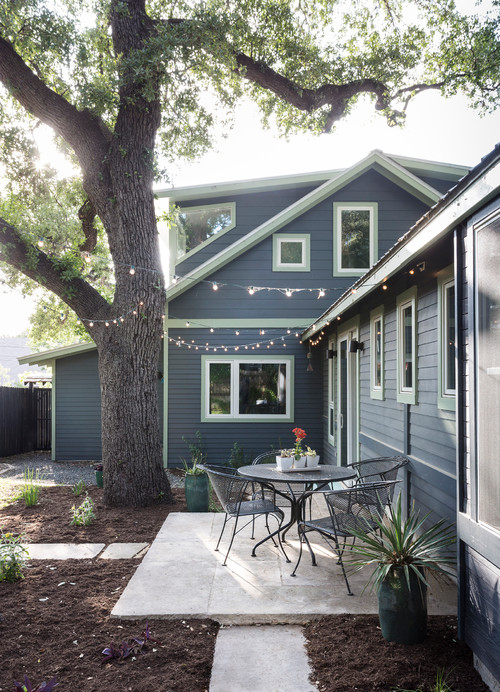
You could also use the time to install new lighting.

“String and lantern lighting is an inexpensive way to elevate the space” and add an element of whimsy, says Shaun McCarthy, a franchisee and owner of Handyman Connection in Colorado Springs, CO.

Cost: String lights and lanterns are about $25-plus

—————

If you have 30 minutes

Photo by Amy Storm & Company

With just a half-hour, you can seriously upgrade your patio with one new power piece and a little elbow grease.

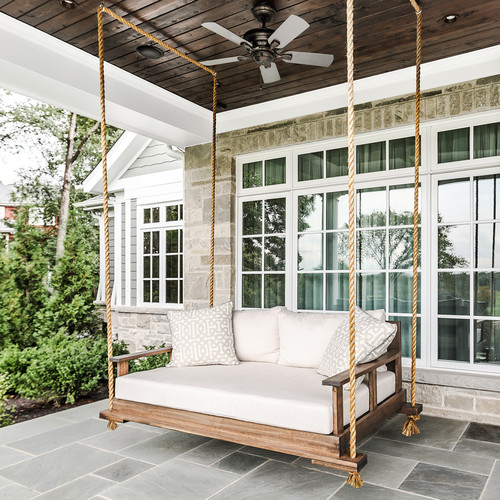
Hanging chairs have become a hot seller as more people seek cozy comfort as they spend time outside. There are a range of options, says Holly Meyer Lucas, team leader of the Meyer Lucas Team at Compass in Jupiter, FL.

“It’s one of the fastest ways to spruce up the outdoor space for people without a lot of time or money on their hands,” she says.

Opt for a Scandinavian-inspired egg chair or a more traditional porch swing style.

Cost: $400-plus, depending on style

—————

Now, look down. Are there any hard edges of the patio that need sanding, rusty nails that need to be replaced, or weeds that need to be pulled?

Phillip Ash, founder of Pro Paint Corner in Falls Church, VA, recommends tackling all of those, and adding new mulch to any garden beds around the patio to add a feeling of “freshness and vibrance” to the patio.

Cost: Sandpaper is $10-plus; mulch is $15-plus

—————

If you have 1 hour

Photo by Weatherill & Associates

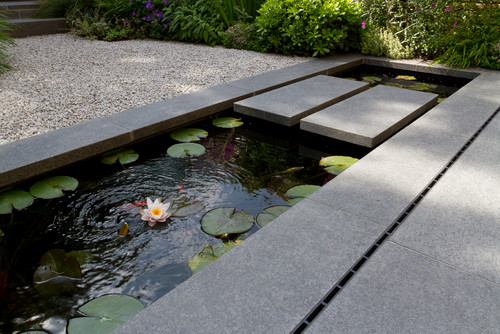
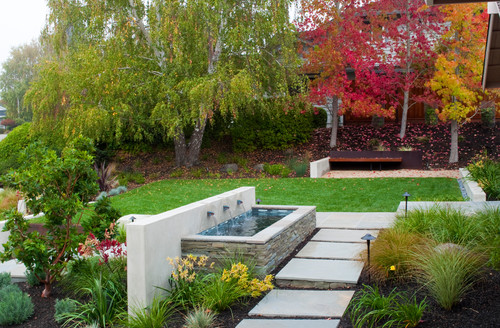
“I’ve found that permanent water features are universally adored,” says Nick Drewe, the CEO of Victoria, Australia–based Wethrift, an e-commerce platform devoted to consumer savings.

In addition to the design benefits, studies have shown that the sound and appearance of running water in fountains can reduce stress.

“I suggest adding one with clean lines, no gargoyles, and nothing over the top,” Drewe says.

Cost: Simple water features are $200-plus

—————

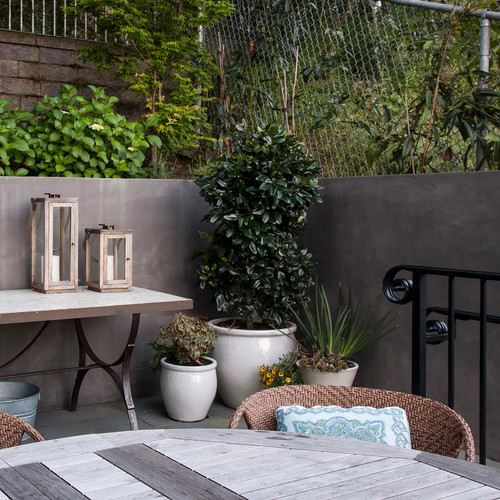
Another way to celebrate the great outdoors with sophistication and restraint is by installing large statement planters and potted plants.

“This is fast and can be a very economical way to drastically improve the patio’s livability and even increase resale value,” says Kris Lippi, a licensed real estate broker and member of the Forbes Real Estate Council in Hartford, CT.

There are many options for pots and planters, so choose a few based on your own style—and don’t be afraid to grab ones with color and texture.

Strawberry plants, begonias, and roses are all beginner-friendly flora that will brighten your patio and put a smile on your face.

Cost: Planters are $20–$100; potted plants are $5-plus

—————

If you have 3 hours

Photo by SJS Studios Inc.

Three hours gives you enough time to give your patio a deep clean. “Remove all of the furniture and rent a pressure washer to get rid of built-up dirt, mold, and algae. You should also use the washer to remove dirt and cobwebs from the side of the house around the patio,” says Fred McGill, CEO and co-founder of residential real estate tech startup Simple Showing in Atlanta.

Cost: Renting a power washer is $30-plus per day

—————

If you have a weekend

Photo by Sweet Smiling Landscapes

With a full weekend, you can take on several of the tasks above, plus one of the projects below (or both if you have helpers).

Installing an extension of your kitchen outside is trending, says Meyer Lucas, and it’s not as difficult and time-consuming as it sounds.

“There are several DIY versions that don’t involve hiring a contractor and can be installed in a weekend,” she says.

You can add a modular kitchen with shelves and a sink, an outdoor serving cart, or even an outdoor refrigerator.

But if you want to go all out with a river-rock backsplash, TV, pizza oven, or working sink, you will likely have to hire a professional contractor (unless you’re truly handy).

Cost: Modular kitchens are $600-plus; serving carts are $100-plus; outdoor refrigerators are $500-plus

—————

The farm-to-table movement has come to the patio, says Christa Hyland, a licensed real estate salesperson at Howard Hanna in Saratoga Springs, NY.

“Small vertical or potted gardens are a great option for people who are new to growing food to try it,” she says.

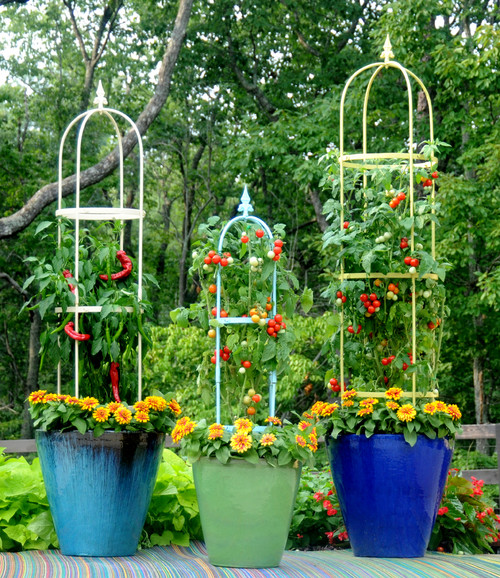
Free-standing or leaning vertical gardens can be used to grow herbs, greens, pole beans, peas, tomatoes, and even vining crops like cucumbers, squash, and melons. Elevated planter boxes, raised beds, and small pots also provide manageable spaces for growing chili peppers, beets, onions, radishes, and other vegetables that will add color to your space and nutrition to your diet.

Cost: Vertical garden supplies are $150-plus; raised boxes and beds are $75-plus; pots are $10-plus

The post The Best Patio Improvement Projects Based On How Much Time You Have appeared first on Real Estate News & Insights | realtor.com®.
Just Add Water: Fountain, Pond, and Birdbath Ideas for a Calm, Cool Yard This Summer

water feature

Getty Images

Every homeowner wants a calm oasis in the backyard. For some folks, this means a fully loaded outdoor kitchen complete with a pizza oven and mini fridge, while for others it’s a simple hammock strung between two trees.

But for the ultimate in backyard tranquility, we’re here to suggest you add a water feature. Cooling and quiet, installing a new H2O design can transform your outdoor space into a true escape.

“Water features can help homeowners attain a ‘vacation in their own backyard’ feeling that so many desire right now during the COVID-19 pandemic,” says Alan Weene, operations manager at Reflections Water Light Stone.

Plus, even a small water feature can act as natural air conditioning, say the experts, and you’ll boost your property’s biodiversity too.

“Water features create a small microclimate, cooling the air on hot days, and they support local wildlife and pollinator species with a source of drinking water,” says Samantha Anderson, landscape designer at Home Outside.

But the greatest benefits just might be psychological.

“Placing oneself in an environment with moving water can promote a high level of energy and a positive state of mind, and may even encourage better performance in the classroom or workplace,” says Weene.

And you don’t have to own a large lawn to get the benefits of a water feature—even city dwellers can squeeze one in, and reap the benefits.

“The sound of water outside your window can be amazingly soothing and help to mask less enticing noise coming from nearby AC units or street traffic,” says Emma Lam, lead designer of A Small Green Space, whose firm designs and installs a variety of garden features in petite urban spots.

Ready to get your feet wet? Here’s what you need to know about various water options for home gardens, including prices and benefits.

Start small with a birdbath

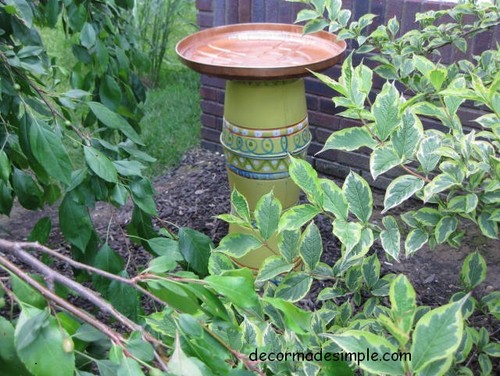
Photo by DecorMadeSimple

The easiest and fastest way to get water into your garden design is to add a birdbath.

“These options don’t require any type of prep work, just a firm, flat surface to sit on, and they quickly add a touch of color and movement to your flower beds,” says Weene.

Birdbath choices are abundant at home stores and garden centers, so try to complement your home’s style and bloom shades when selecting one. Caring for this birdie pool is a snap—just keep it filled, fish out leaves and sticks when you notice them, and do a deeper clean seasonally.

Try a bubbler fountain

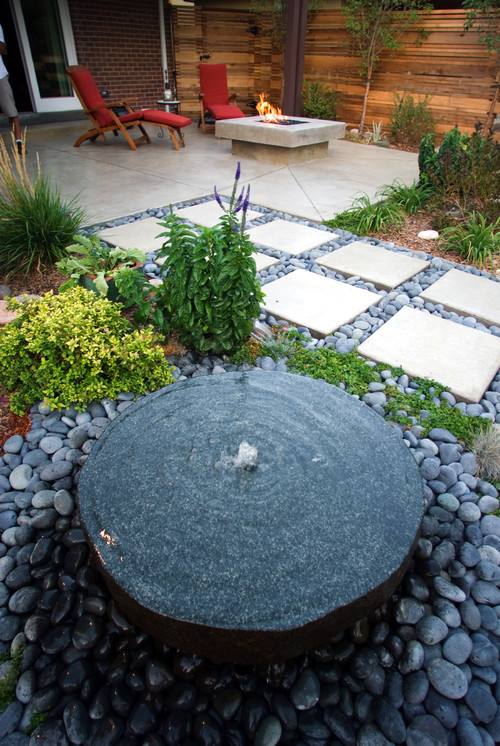
Photo by Mile High Landscaping

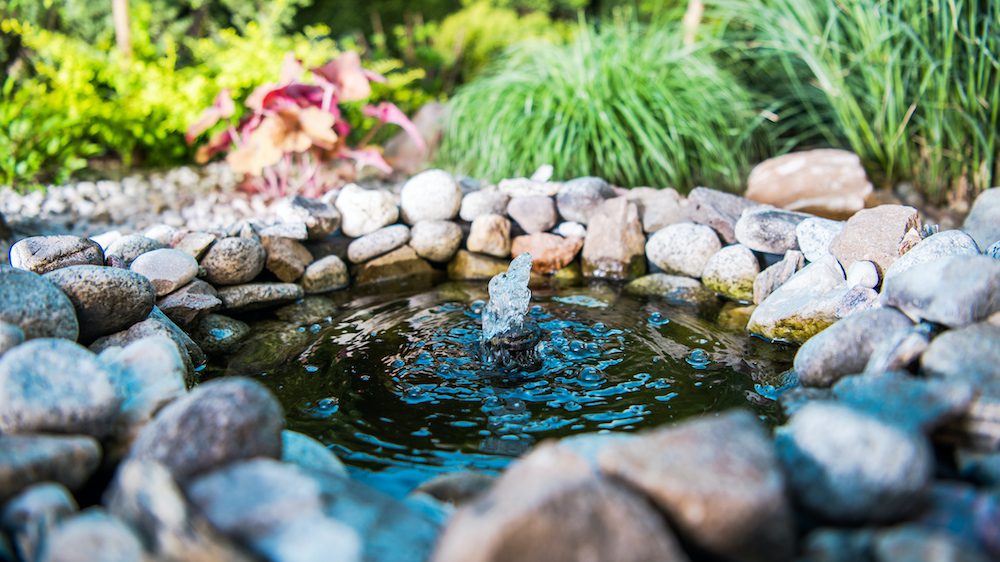
Another easy pick in terms of maintenance and installation are bubble fountains, which are basically pre-packaged or free-standing options that come ready to go. (Just add water and plug it in.)

Lam is a fan of compact recirculating water fountains for small spaces like city decks and patios.

“Bubble fountains have a reservoir that you fill, and their gentle burbling provides ambient sound as well as a visual feature,” says Gary McCoy, a Lowe’s store manager and lawn and garden expert.

Bubblers, like birdbaths, can match your outdoor space’s theme.

“The ‘fountain’ portion can be a rock, stone statuary, or something made from fiberglass or metal,” says John Cook, landscape installation manager at FormLA Landscaping.

Dig a pond

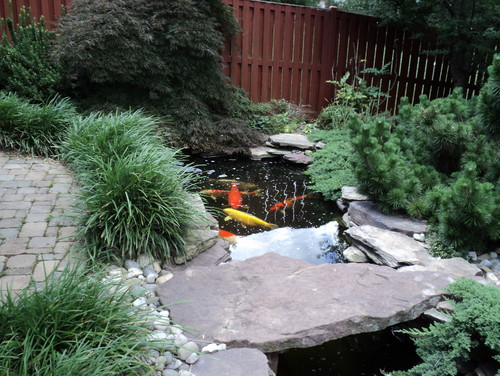
Photo by Sharon Ross 

The next level up in degree of difficulty (e.g., installation, maintenance, cost) are ponds. You can definitely go the simple route, says McCoy, by “digging a form, lining it with plastic, filling it, and then installing a pump.” But these features can also be highly complex.

“Custom ponds, streams, and waterfalls require considerable space, time, and expertise to put in successfully as these include excavation, plumbing, mechanicals, and decorative plantings to surround it,” says Weene.

Water feature costs

Photo by John Davies Landscape 

You can expect to pay $40 or so for a small platelike birdbath that sits on a table or a few hundred, depending on the materials it’s made from.

“A small DIY pond could potentially be realized for a few thousand dollars, but once you add rocks, fish, plants, and filtration, that price can quickly increase,” says Weene.

And if you’re keen to put in a larger pond, waterfall, or natural pool, get ready to pay tens of thousands of dollars.

“As a rule of thumb, the budget for a professionally designed and installed water feature might be $100 to $150 per square foot,” he says. And don’t forget the power source details.

“Consider utilities, such as electricity, a waterline, or whether your water feature is solar-powered,” says Anderson.

Photo by Huettl Landscape Architecture

The post Just Add Water: Fountain, Pond, and Birdbath Ideas for a Calm, Cool Yard This Summer appeared first on Real Estate News & Insights | realtor.com®.
Monday, April 26, 2021

6 Lessons First-Time Gardeners Learned During the Pandemic

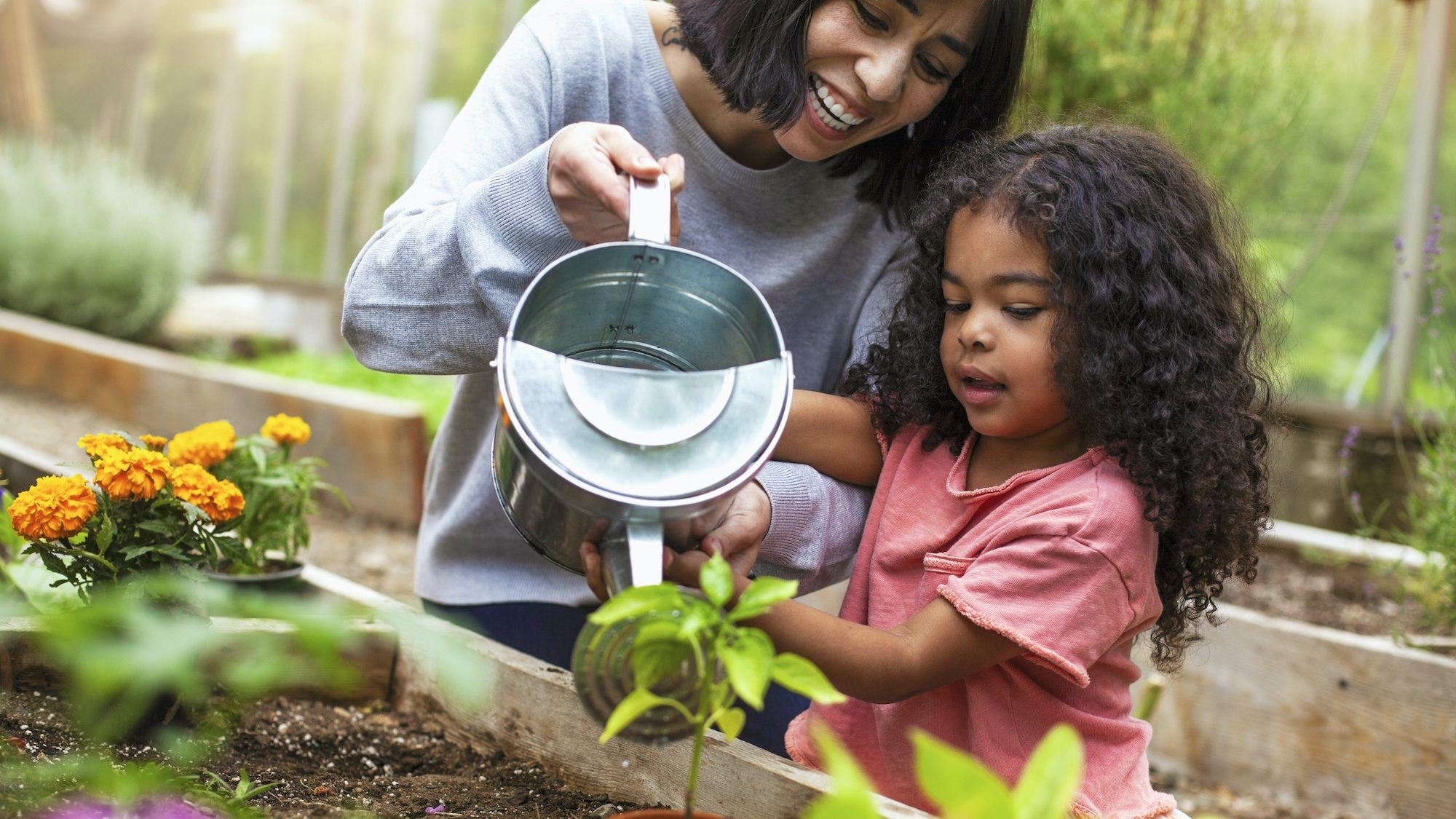
Mother and daughter watering plants

Getty Images

When the COVID-19 pandemic first forced us to shelter in place, many homeowners reacted by taking up trowels and digging in the dirt. By planting victory gardens, folks tried to beautify their backyards and skip those long lines at the grocery store by raising their own crops of lettuce, tomatoes, and strawberries.

Alas, not every newbie gardener found success in these endeavors. Mixed with the joy of seeing those first green shoots poke up, or fruits budding on the vine, there was also frustration and bewilderment at crops that just didn’t take off.

But veteran gardeners know to learn from past mistakes as you plan your future garden. So in order to improve your chances for this year’s garden, take heed of the valuable lessons some folks learned after planting their first fruits and vegetables last year.

1. Don’t let tomatoes take over

Photo by Steve Masley Consulting and Design

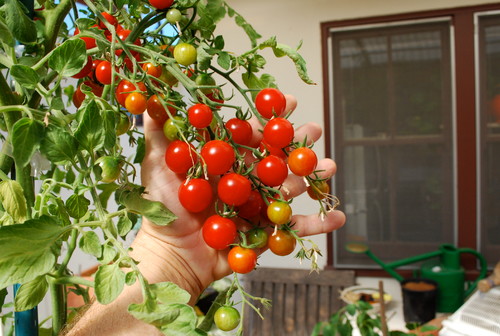
Who knew you’re supposed to prune cherry tomatoes before they get too big? Not Liz Rossetti of Hamilton, MA.

“By not pinching them back as they grew, this vinelike plant went crazy and just took over the whole raised bed,” she explains. She was thrilled to have a bumper crop of tomatoes to harvest, but this could put neighboring plants in jeopardy.

“Homeowners also don’t check the size of the plants they’re putting in—and if a garden is oversown, many of the plants will eventually perish as they’re choked out,” says Emma Lam, master gardener and lead designer at A Small Green Space.

2. Don’t forget to feed the soil

Photo by Falon Land Studio LLC – 

Kate Stober recently relocated to Tempe, AZ, and tried gardening there in February 2020. It’s definitely been a learning curve, she reports: “The seasons are topsy-turvy, the soil is terrible, and the sun kills everything.”

Despite these challenges, she was able to make a lot of things grow, especially when she realized she should boost her soil’s health with worm castings, a type of organic fertilizer.

Susan Brandt, expert soil tiller at Blooming Secrets, agrees with this savvy move: “One of the bigger mistakes people tend to make is not preparing their soil properly or enough—compost is another good fix here.”

Of course, to prepare your soil properly, you need to know what it’s like and what it’s lacking. You can get a soil test kit from any home improvement or gardening store. The results will tell you what you need to add to your soil to help your plants flourish.

3. Watch how you water

Photo by Story Design and Construction, Inc. 

“Overwatering, underwatering, and not providing enough drainage for water to seep out of containers and pots are very common errors that new gardeners make,” says Brandt.

It seems that watering confounds everyone.

“As a professional landscape designer, I have never seen an in-ground garden die from overwatering, but have seen many die from too little water, which is why I highly recommend automatic irrigation systems,” says Lam.

The upshot: It makes gardening a lot easier—and more enjoyable.

Kristy Esparza of San Jose, CA, learned this lesson early on.

“Now that it’s spring again and we’re on to Round 2 of our backyard garden, we’ve purchased self-watering containers, which help a ton because I still struggle to understand exactly how much water each plant needs,” she says.

4. Don’t plant too early

Photo by KL Designs Residential Landscape Planning LLC 

Check the weather forecast, people!

Sabrina Beaumont, chief marketing officer at PassionPlans, lost nearly all of her new plants and had to start over when a night of serious chills hit her area.

“I learned you have to be aware of frost dates, so I downloaded an app, which can help warn me when it’s going to happen the next time,” says the Raleigh, NC resident.

“You’d think that once spring arrives that you can plant, but putting in heat-loving flowers too soon could mean their death,” notes Brandt. The same goes for soil that’s too cool. (Seedlings sown too soon may not grow, or their roots could rot.)

5. Put down weed barriers

Photo by Lankford Associates Landscape Architects 

Greg Halter wasn’t a fan of all the weeds that took root in his garden.

“Weeds consumed some of our tomato plants and killed off our pepper plants, so this year I’m putting in the effort and installing proper weed control barriers,” says the Benton, KY, resident.

While landscape fabric from the home store is often a go-to, our experts point out that there are loads of DIY options for keeping weeds at bay, including gravel, newspaper, cardboard, straw, mulch, and burlap.

6. Don’t wait too long to stake stalks

Photo by Pamela Crawford & Associates 

Christi Kelly of Columbia, MO, knew she had to support her pepper plants when they got tall—but the season slipped away from her.

“They started growing fast midsummer and by the time I got stakes in the pots, the stems were stressed and bent over,” she relates. Kelly was able to rig them up with fabric ties, but the damage was done and the plants didn’t thrive.

Brandt chalks this one up to a case of biting off more than you can chew.

“Trying to do too many things in the garden all at once can leave you feeling overwhelmed,” she shares.

Your best bet: Plant what you have the space, time, and energy reserves for—and then expand from there.

The post 6 Lessons First-Time Gardeners Learned During the Pandemic appeared first on Real Estate News & Insights | realtor.com®.
‘Everything But the House’ Reveals Clutter Worth $35,022—Do You Have Some, Too?

everything but the house

HGTV

Decluttering a house is not just smart to do before you sell—the “junk” within could actually be worth tens of thousands of dollars.

That’s the premise behind HGTV’s new show “Everything But the House,” where host Lara Spencer works with home sellers to find what castoffs could be sold for major money.

In the episode “Hiding Tons of Treasure,” the crew goes to Medford Lakes, NJ, to meet siblings Michael and Eileen Dzwill, who are tasked with cleaning out and selling their old family home. Working with expert appraisers Michi Lee and Jacquie Denny, this team combs through the entire property for items to sell at auction.

When Spencer and her team are finished, the auctioned items make the Dzwill family a staggering $35,022. Here are the surprising household items that earn Michael and Eileen the most money. Maybe you have similar unexpected treasures in your home?

Concert T-shirts and vintage clothes

t-shirts
These Grateful Dead shirts sell for a shocking $325.

HGTV

In the closets, Spencer, Lee, and Eileen find three 1992 Grateful Dead T-shirts.

“My brothers’ friends would always buy something cool for my dad,” Eileen says when they pull the shirts out of the closet. “So maybe they got them for him.”

Lee estimates that these three shirts will probably go for $50 to $75, but when these shirts are finally auctioned off, Eileen and Michael are surprised that they net a total of $325!

But the real moneymakers are two 1950s coats by Pauline TrigĆØre, a famous designer who worked for Jackie Kennedy and did costumes for the movie “Breakfast at Tiffany’s.” The team finds these coats in the closet, and Eileen is delighted when they end up selling for $621.

It’s a good reminder to always give old clothes a second look.

jackets
Always remember to check the closets for valuable vintage clothes.

HGTV

Old toys

Barbies
These classic Barbies are collectibles.

HGTV

Old toys can be serious collectors’ items, so it’s no surprise when Lee and Denny say that some of the old kids’ toys may be worth something.

A box of marbles sells for $200, while Eileen’s old set of Barbies goes for a staggering $310.

Another big item is an old-fashioned bisque doll, which Denny says could go for $400 to $800.

“Those are real enamel teeth, and then they used human hair for the wig,” Denny says.

doll
This old doll may be creepy, but someone pays a good price for it.

HGTV

Unfortunately, this doll sells for only $175 at auction, but when Eileen admits she finds the doll creepy, it seems she’s happy to get rid of it at this price.

Silverware

silverware
This silverware looks great, but it’s not worth much.

HGTV

Eileen and Michael hope that their mother’s old silver will be worth a lot, but Denny says it isn’t too valuable.

“This is actually silver plate, not sterling silver,” Denny says. “Silver plate has much less value because it doesn’t have the fine metal content that sterling does, and so you’re probably looking at about $125, $145 for the set.”

The set actually sells for only $75, but Eileen and Michael show Denny another set of silver, which Denny says is indeed sterling silver. This one sells for the much higher price of $1,200.

Artwork

art
These paintings were just sitting in the greenhouse.

HGTV

While plenty of treasures can be found in the house, it’s also important to check any garage, shed, or storage outside the main living area.

In the greenhouse, they find a large crate with three paintings on silk from about the 16th to 19th century.

While Denny says these pieces could be very valuable, they can’t be attributed to an artist, so they aren’t big sellers. One piece goes for $350, while the other two sell for $150 each. While that may not seem like a lot for these old works, it’s better than nothing.

And as Spencer points out, Michael and Eileen are lucky these items weren’t damaged in the greenhouse.

“The thing is leaking, it’s about to fall down, and meanwhile, there are really valuable things all over the place,” Spencer says.

Millstones

millstones
These millstones fetch a surprisingly high price.

HGTV

Spencer, Michael, and Denny find some great artifacts in the greenhouse, but they find more valuables in an even more surprising place: the garden.

“These, by the way, are also collectible,” Spencer says when she spots three millstones. “You see these at big-box stores on stands, and people put them on their bookshelves.”

These three millstones end up fetching an impressive $130. Michael is shocked. “I’ve got to go dig up the yard a little more,” he jokes.

The post ‘Everything But the House’ Reveals Clutter Worth $35,022—Do You Have Some, Too? appeared first on Real Estate News & Insights | realtor.com®.
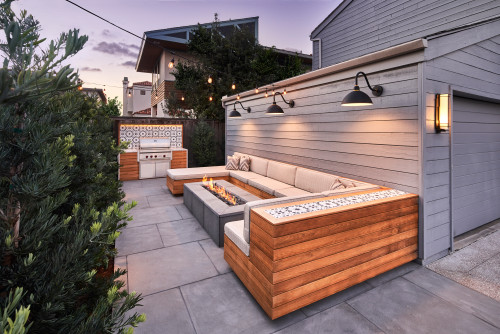
What Is a Keyhole Garden? The Hottest Trend Since Victory Gardens, Explained

keyhole garden

K. Latham / Flickr

Planting a victory garden may have been last spring’s big trend, but if you’re looking to take your gardening to the next level, try the newest craze: a keyhole garden.

What is a keyhole garden? It’s a circular raised garden bed standing 2 to 3 feet tall, with a keyhole-shaped cutout on one side (hence the name). This allows gardeners to enter and easily reach all plants for easy access weeding, harvesting, composting, fertilizing, and more.

In addition to making gardening easier, keyhole gardens tend to yield more produce, based on their innovative design. Here’s more about keyhole gardens, how they work, and what it takes to build one in your own yard.

What is a keyhole garden?

Keyhole gardens originated in Lesotho, a small country in South Africa. Due to the arid climate here, these gardens are built to flourish amid dry conditions and in areas with poor soil quality.

The key to a keyhole garden is its center—a raised mini compost container where gardeners add food waste and manure, which decompose and then seep into the surrounding soil.

“When you add compost in the center, it decomposes and feeds the plants around it,” says Hector MardueƱo, owner of Las Vegas landscaping company Stonewall Creek.

Since these nutrients spread only so far, this is why keyhole gardens are round, and not too large.

How does a keyhole garden work?

Another smart aspect of keyhole gardens is the layers of compost within these raised garden beds, says Chelsea Wells-Barrett, gardening expert and founder of the blog Grow Where You Sow Homesteading.

The bottom of the entire garden bed is the thickest, made up of things like decaying logs or branches. The next layer is compostable material such as grass clippings or straw. Layer three is compost. And all of those layers are topped with soil.

Over time, the bottom layers break down and create a rich humus that continuously increases soil quality, provides your plants with nutrition, and helps balance heat and water retention.

The benefits of a keyhole garden

First up, keyhole gardens equal less work overall as the layers of composting organic matter cut down on the watering and feeding most gardens demand.

Keyhole gardens are also perfect for a small yard, as the keyhole access makes it easier to weed, feed your soil, and harvest vegetables. And keyhole gardens are a good option for anyone with mobility issues or a bad back as there is no prolonged crouching, bending, or reaching involved. (Thanks, keyhole!) They’re also ideal if you have a yard with poor soil.

Live in a hot, dry, or warm climate? “A keyhole garden’s raised bed keeps the soil moist all the way through for a healthy growing environment for plants and veggies,” says MardueƱo.

Why are keyhole gardens a big trend now?

In the past, many green thumbs opted for the standard raised bed. But when the pandemic started, people seemed to want to live a more self-sustaining life that includes garden-fresh veggies.

“People likely found that keyhole gardens were not only affordable and a less labor-intensive method of gardening, but they could be a creative addition to a yard,” says Wells-Barrett.

How to build a keyhole garden

First, find a place in your yard and measure out your keyhole garden based on your arm’s reach from the keyhole center. Keep in mind some people build multiple keyholes rather than one large one.

Next, decide on what material you want to use to build your barrier wall. Traditional keyhole gardens are often created with a stone retaining wall. But they can be built with any material strong enough to support the layers of organic matter—think stone, brick, or treated wood (just use a plastic liner to prevent rot).

The barrier wall should be about 2 to 3 feet tall. Once that’s built, construct your compost pile in the center of the garden. The cylinder should be made out of a material that drains easily and lets worms pass through. (Fencing wire is a good option.) And the tube should be about 12 to 18 inches taller than your growing area as an active compost pile needs room to heat up and break down.

Finally, add your four layers to the bed and plant away!

How to keep your compost pile healthy

When you create your compost pile, go for a roughly 3-to-1 ratio of nitrogen to carbon-rich materials to help jump-start the natural decomposition process. Nitrogen can be found in food scraps, fresh grass clippings, or animal manure. Meanwhile, carbon is hiding in raked leaves, straw, or shredded newspaper.

As you water and turn your compost pile, the nutrients and water will drain into the growing space surrounding it.

“Your compost pile is healthy when it’s as moist as a wrung-out sponge,” says Wells-Barrett. If your pile is wet or smelly, add carbon. If your pile is too dry and not decomposing, add nitrogen, and you’ll be well on your way to fresh veggies with minimal effort soon enough.

The post What Is a Keyhole Garden? The Hottest Trend Since Victory Gardens, Explained appeared first on Real Estate News & Insights | realtor.com®.
‘Home Town’ Season Finale Unveils a New Color We’ll Bet You’ve Never Heard Of

home town

HGTV

“Home Town” stars Erin and Ben Napier have just aired their Season 5 finale, and the house they renovate shows off their signature Southern style like no other before.

In the episode “Grand Style,” Erin and Ben meet with Cindy Marek, who knows she’ll need a big house for her visiting kids and grandkids. She ends up buying a four-bedroom, four-bathroom house for $300,000 that has plenty of space—it just doesn’t have much personality.

Erin and Ben need to give this house a massive makeover, but only have $100,000 for renovations. In the end, though, the Napiers only spend $75,000 of their reno budget, and the house has Southern charm in spades. Here’s how they freshen up this home’s interior, which might inspire you to try a few new upgrades (and paint colors!) in your own home, too.

‘Haint blue’ can help keep spirits away

house
This porch is a great place to hang out.

HGTV

When Marek first sees the house she ends up buying, she gushes over the front porch. So, of course Erin and Ben want to give it some serious Southern charm.

They add a porch swing and, to finish it off, paint the ceiling a color we’d wager that many people haven’t heard of before, unless they’re from the South. It’s called “haint blue”—a variation on the word “haunt” that’s believed to keep away spirits.

“You’ve got to have a haint-blue ceiling,” Ben says. “If you live in a grand Southern home, it’s sort of required.”

porch
This blue ceiling adds a classy touch of color.

HGTV

In addition to keeping ghosts away, haint blue adds a subtle splash of color to this porch in a surprising place that you might not even notice, unless you look up.

The right wallpaper pattern can feel fresh and fun

wallpaper
This space needed a pop of color.

HGTV

It seems wallpaper has come full circle!

At the beginning of the renovation, Erin knows that Marek will want some wallpaper in her home’s entryway; she just isn’t a fan of the peach wallpaper currently in the space. So, she asks Marek’s nephew Adam to design a custom wallpaper with adorable little trees.

wallpaper
This custom vinyl wallpaper adds color to the room.

HGTV

“It’s really going from a very formal and stuffy space to feeling playful and whimsical and colorful,” Erin says. “And I think it’ll make her smile every time she walks in the door.”

While wallpaper can feel old and formal, a unique design and a bright color can keep it feeling youthful. As it turns out, this wallpaper is mature enough for Marek, but it will also be youthful enough to impress her grandkids, too.

Tongue-and-groove paneling adds character

paneling
This paneling adds lots of character.

HGTV

This old house comes with tongue-and-groove paneling in the dining room—and Marek loves it! However, the wood tone clashes with the darker wood flooring, so Erin decides to paint the walls blue.

When the paint is finished, Erin is impressed with the vibe in the dining room. The paneling gives this room lots of personality, while paint on a basic wall might have looked too plain or formal.

“It’s a really nice contrast—of formal and kind of rustic,” she says.

paneling
Painting this paneling blue gives the dining room a sophisticated look.

HGTV

A copper hood vent can be aged to look amazing

hood vent
This hood vent is perfectly aged.

HGTV

In the kitchen, Erin wants to make a statement with a copper hood vent.

So, she orders a custom copper piece, aged perfectly to give the kitchen a classic feel.

“Copper is such a cool metal,” Erin says, adding that “different wools or chemicals or substances change the color and the texture of the metal.”

While it only takes heat and some dish soap to age this copper, the look really elevates the style of this kitchen. The aged copper has a dark, earthy color that Erin and Marek love.

“It looks like woodworking, but it’s metal,” Erin points out.

Add windows to let in more light and a nice view

This kitchen was dark and closed-off.

HGTV

While the aged hood vent looks great, Erin and Ben know that even the best kitchen upgrades can’t compare to the beauty of nature. While this kitchen starts off awkward and closed-off, Erin and Ben decide to open up the layout and add some large windows to the back wall, giving the kitchen a perfect view of the backyard.

“So now, Cee Cee can sit in her kitchen, and keep an eye on them grandkids,” Ben says.

kitchen
Adding windows makes a big difference.

HGTV

The post ‘Home Town’ Season Finale Unveils a New Color We’ll Bet You’ve Never Heard Of appeared first on Real Estate News & Insights | realtor.com®.